Showing posts with label London. Show all posts

Saturday, 29 May 2010

Technology worship rituals: Katie Paterson and Adam Dix at Haunch of Venison, London review


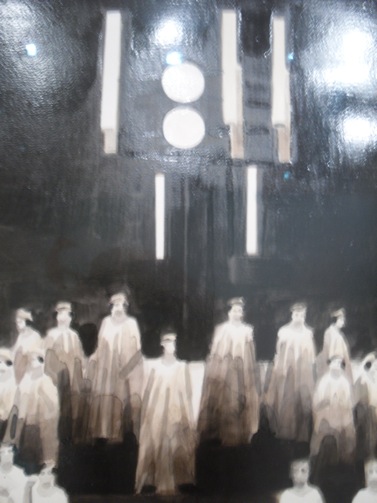
Detail of painting by Adam Dix, photograph copyright Margaret Sharrow 2010


If you are visiting the Royal Academy, perhaps to see the Glasgow Boys, Treasures of Budapest, or to pop into No New Thing Under the Sun (the latter being a very interesting mixed exhibition in a room, free until 9 January 2011), take yourself out the front exit, turn right, right again, and come to the classically columned front directly behind the Royal Academy. This is Haunch of Venison, part of a series of high-end private galleries (there are also Haunches in Berlin, Zurich and New York), that sometimes acts as an overflow exhibition space for the RA (as with the excellent Earth exhibition in 2009. The quality of work in Haunch of Venison is always extremely high, and frequently much more cutting-edge than the work at the other galleries strung along Cork Street, which is what you face when you leave the gallery. The work never feels crowded in the generously sized rooms, yet it is not the ultramassive space that one finds in the Saatchi Gallery, or the Baltic in Newcastle.


Recently, there's been work by, among others, the pop artist Tom Wesselmann. But for me the real standout was an extensive series of paintings by Adam Dix and conceptual works by Katie Paterson, part of the Transmission exhibition that ran from 7 October - 6 November 2010. Perhaps they are people who, like me, was captivated by the PBS television series Cosmos hosted by Carl Sagan, with his stories of humanity's relationship with the wider universe. In effect this is Adam Dix's theme: the paintings depict humans engaged in ritual, borrowed from a range of iconographies: medieval, processional, photographs of gymnastic exercise, weddings and early television watching. But in each case the ritual is juxtaposed with an anachronistic item of technology. The bards at a Welsh eisteddfod are grouped around a microwave transmission tower. Traditionally costumed festival goers of indeterminate European origin bear satellite dishes at the end of poles instead of flowers or candles. An idealised 1950s family watch television, their ears plugged into iPod earphones, with curious white discs, or nimbuses, hovering over their heads. It is at once dislocating, slightly uncomfortable, and yet it makes sense. Are the people ritualising the technology, worshipping it as people did other things in the past, really us? Are we just as superstitious now, in a way that we imagine to be perfectly rational?


Paterson's work takes us further and further from earth. E.M.E. stands for 'Earth-Moon-Earth', an installation comprising a baby grand piano that plays itself, according to a score that can be followed from a nearby book. The music is Beethoven's Moonlight Sonata, which was translated into Morse code (which das and dits you can hear through headphones), distorted by bouncing off the surface of the moon, and beamed back, minus a large number of randomly spaced notes. This is the version that the automatic player-piano-with-electronics-not-paper-scrolls presses out, mechanically, endlessly, with odd lacunae, pauses and hesitations, and short intervals of silence just before the final cadence. Translation, mistranslation, mechanical misunderstanding. Beethoven sang an ode to the moon, and at last the moon sings it back to us. The moon appears again in a different installation, in which a single bulb hangs in an otherwise dark room, emitting light balanced not to mimic daylight, but moonlight. Nearby is a box with a lifetime's supply of such bulbs. Moonlight for life.


In a different room, a box full of slides of a potentially infinite series of photographs of space. No stars are visible (though many are pinpointed on a nearby work): a series of sample prints are all uniformly blank. They are stamped by Paterson with their edition numbers: an infinitely tiny number in a set comprising infinity. Photographing every sector of space is a project that will never finish. The physical expression of these works, i.e. what is in front of you on the wall, is less compelling than the other pieces. But the impact of the idea, which sets you free in Sagan's 'spaceship of the imagination', is far more powerful.


more images from the exhibition


Katie Paterson at Haunch of Venison website


Katie Paterson's website


Adam Dix's website


Katie Paterson at Haunch of Venison: more images


All photographs are installation views and many are details.
Copyright of the images remains with the artist Katie Paterson.
Photographs by Margaret Sharrow, 2010


Rachel Whiteread Drawings: studies in negative spaces, places for play - Tate Britain 8 September 2010 - 16 January 2011


Photo: Rachel Whiteread video on display in main foyer, Tate Britain, to accompany her exhibition. Photo copyright Margaret Sharrow, 2010; video copyright Tate

It's always interesting to see artists' preparatory work (see Francis Alÿs, 'A Story of Deception'), and this selection of drawings, photographs, maquettes and items from the studio of former Turner Prize winner Rachel Whiteread makes a nice complement to the current year's contenders' exhibition. There are many drawings made on graph paper, and I began to wonder what benefits this might offer her (scaling up? guidance against a tendency to stray from the straight line?), and why I hadn't tried drawing on graph paper myself. She is also fond of using whiteout as a drawing tool, something Michael Landy has used to great effect in some of his drawings of Tinguely's Homage to New York.

As a photographer it is always interesting for me to see what use non-photographer artists make of this medium. There was one photograph of an urban landscape, a study for her water tower piece I think, that she had painted over, giving a very atmospheric result. Other photographs were daubed with whiteout to indicate the negative spaces that are the hallmark of her sculptural work. (The idea of highlighting the negative space, the invisible thing in preference to the apparently existing things, is one that appeals to me greatly.) There is the famous house, blotted out while its neighbours remain. There is another photograph of the field, after the standing guts of the house that was Whiteread's seminal work had been demolished by an anxious council. An absence of an absence. Perhaps we should be visiting this ghost of a work that was a ghost of a house.

I also liked her plans for the fourth plinth in London's Trafalgar Square - to have the mirror image of the plinth stood on top of itself, made of some translucent material. 'Do it! DO IT!!!' I shouted to her, though she wasn't there. Fortunately I did all this shouting in my head, or they would have thrown me out before I could have seen some of the most interesting work: studies on modified postcards (one filled with negative spaces through the aegis of a range of differently sized hole punches), and a vast array of handholdable (but sadly safe behind glass) treasures she keeps in her studio: glass globes and crystal balls, a mould of Peter Sellers' nose that was a sample from a sculptural materials company, single shoes, toys, stones, resin moulds of bowls, mirrors and other delightfully reflective surfaces. Such is the stuff we need to have about us, for reference, for inspiration, for play. For it is play that allows us to connect with the unfettered, uncluttered self that can create with clarity.

A bonus exhibition that can be seen on a combination ticket with Eadweard Muybridge and the Turner Prize.

Rachel Whiteread Drawings continues at Tate Britain, London, until 16 January 2011

Posted 9 November 2010

Ai Weiwei: Sunflower Seeds: a field of could-be sunflowers... but not a beach


Photo: Ai Weiwei's 'Sunflower Seeds', Turbine Hall, Tate Modern, London. Image copyright Margaret Sharrow, 2010.


I must admit I was quite excited at the prospect of the next Turbine Hall installation at Tate Modern, having enjoyed Mirosław Balka earlier in the year. And there was certainly quite a buildup: I'd read the article about Ai in Tate Etc, and heard the folk on Radio 4's Front Row enthusing about how much it was like a beach, how people were walking on it, sitting and lying down and making sandcastles out of the 100,000,000 ceramic sunflower seeds.

So imagine my disappointment to discover, first of all, that by the fourth day of the exhibition, access to the work was barred (i.e. you couldn't walk on it as Ai intended), and second, that it didn't fill nearly as much of the Turbine Hall as I'd imagined. This second disillusionment was entirely a product of my own fevered imagination, being a hazard of getting much of my art news from the radio: I had formed an image in my mind of a Turbine Hall packed nearly to the rafters with seeds, that were slightly larger than life size and made of unpainted grey porcelain. This image persisted despite the fact that I had watched Newsnight with Ai interviewed standing on his work, right there in the public library on iPlayer, so plenty of witnesses that I did not see Ai brushing his head against the ceiling. In fact one hundred million precisely lifesized porcelain sunflower seeds barely covers the floor to a depth of four inches (10 cm). I suppose a 30-plus metre depth of sunflower seeds would constitute a genuine health and safety hazard (tabloid headlines spring to mind: 'man, 46, drowns in art'), but porcelain dust? Surely visitors' time on the piece could be limited, or misters employed at designated times to settle the dust, or we could all be forced to read copious safety warnings before launching ourselves into the unknown. I appreciate that Tate must protect itself from possible lawsuits, but somehow the same gallery allowed us to experience Cildo Meireles' powerful installation that involved potential asphyxiation from impenetrable clouds of talcum powder in a confined space.

All this discussion of access to the work is bound to overshadow the meaning of the work, which had shown its potential to generate joy, playfulness and happy seaside memories in a culture that does not have the same associations with the sunflower seed as the Chinese (even if we snack on sunflower seeds, most of us buy them shelled). These pieces are meticulously crafted. A hundred million, all superficially the same yet subtly detailed in minor variations - they are extremely accurate replicas, stripey and unglazed, an amiable attendant having let me hold a few in my hand. Each one inevitably representing - a person, so less than one tenth the population of China, two thirds would represent the population of Britain with the leftover part accounting for, I don't know, annual tourists to Britain. Or maybe just annual tourists to London, I'm not sure. Each one quiet and humble. In fact many were obviously disappointed by the sheer ordinariness of it all. 'Is that it?' one woman cried. She might have been happier with ten thousand sunflowers in bloom, bright faces replicating Olafur Eliasson's The Weather Project, shown in the Turbine Hall in 2003-2004). Of course the seeds are the potential for a thousand times more sunflowers. And they are also like the infamous butter mountains and wine lakes of the European Union's notorious Common Agricultural Policy, a superabundance of food in a world where so many do not have enough to eat.

Given Ai's track record as an artist who is largely an activist (in some lights, perhaps an activist who is largely an artist), readings similar to this last may lie closer to the artist's intention. Millions dressed identically in drab Mao suits, five year plans to produce mountains of food to feed the millions, to produce grey metal to launch China's industries in the collective fervour of the past. Millions going to work in suits in the booming present, or perhaps millions of political prisoners over the decades, if prisoners wear grey? Millions of mobile phones, iPods, and all the other silver consumer goods. Millions of tons of rubbish, that will be left by the empty shells of seeds, and of consumer goods discarded. And while the numbers trapped by recent earthquakes are far less, that grey horde is never far from Ai's mind.

Still, all these possible readings have come to me after the event. When I was there, I just wanted to play on a beach. And so I sat forlornly behind the barrier tape like a kid at the pier on a rainy day, glumly tossing my sample seeds back into the multitude.

Unilever Series: Ai Weiwei's Sunflower Seeds continues at the Turbine Hall at Tate Modern, London, until 2 May 2011 (according to the Tate link below; the bimonthly Tate magazine says 25 April 2011). Free.

Check with the Tate page for latest updates on the access situation

I wrote this review, then I read the others below, which are worth a look for further contextualisation, to learn that over a thousand people were employed in a Chinese pottery-making town to create the seeds by hand, and that Ai also sees the work as being like the mass of small contributions on Twitter:

Adrian Serle


Charlotte Higgins

23 October 2010


Review: Kyle Bean's windows at Selfridges, London


An exploded motorcycle, each piston, gear and lever separate, hangs in balance with its assembled twin. The cardboard box for an office chair is hung against an office chair constructed from the same box. Artist Kyle Bean created a series of shop window displays each featuring a giant balance scales with pairs of objects in transformation. The concept behind the work was to illustrate the third law of thermodynamics, which states that energy can neither be created nor destroyed, but changes from one form to another. I encountered these interesting works, not at Selfridges in London where they were on show from July until 1 September 2010, but on the Creative Review website, where I left the comment that follows:

I wonder if the commission of these new artist-designed windows is in part a response to Louis Vuitton's new shop on New Bond Street, which with its gold peek-a-boo mesh, animated shoes and glass globe-encased fantasy animals composed of leather handbags etc. has set a new standard for shop windows. Bean's disassembled motorcycle bears a superficial resemblance to the assemblage of cogs, wheels and scrap metal in Michael Landy's 'Credit Card Destroying Machine', partially visible through the LV window - but without the functionality and complexity of references seen in Landy's work. I do like the idea and careful execution of Bean's work, and am always happy to see integration of scientific ideas into art. But as others have said, it would have been nice to see the works balanced on a hair, perhaps moving gently, alarmingly, with a current of air. And what are these pairs of things equivalents of? Transformations of themselves? On first glance I thought perhaps they represented something like carbon footprint equivalents of themselves - the work might have had more weight (excuse the pun) if they had. Yes, I know that would have destroyed the thermodynamics theme. However, to be really picky, the pairs as displayed can't be absolute equivalents as energy must have been contributed to make the transformations, and the law of entropy says that energy gets used up within a closed system, and that over time there is greater disorder (as with the motorcycle) not more order (as with the castle). Perhaps this is reading too much into what is, in the end, a shop window display... but the publicising of the presence of the artist inevitably invites a higher level of scrutiny than the work of an anonymous window dresser, however innovative.

Regardless, it's fantastic to see more art in shop windows!

Image from http://www.creativereview.co.uk/cr-blog/2010/july/kyle-bean, where the above comment originally posted.

Thursday, 15 April 2010

Go, go, go to Van Gogh at the Royal Academy, London


Van Gogh at the Royal Academy, London. Photo copyright Margaret Sharrow, 2010

Only 3 days left to see the excellent Van Gogh exhibition at the Royal Academy in London! I would recommend queueing from at least 8:30 am, if not earlier (doors open at 10). Unless you get fed up waiting, like a woman I met, and would rather pay £80 for a membership (which admits two to all Royal Academy exhibitions for a year). Otherwise tickets are £12, with concessions available. It is a bit of a scrum inside, and can only get worse, but it's still absolutely worth it. And they've knocked the catalogue price down to £12.99.

Review to follow here, very shortly.


Queue for Van Gogh, Royal Academy, London. Photo copyright Margaret Sharrow 2010


Monday, 12 April 2010

Evolution of the cock's comb: Arshile Gorky at Tate Modern

Arshile Gorky: A Retrospective

Tate Modern, London

Until 3 May 2010


Being originally from Buffalo, I have, amongst my mental wallpaper from the Albright-Knox Art Gallery, an image of Arshile Gorky's painting The Liver Is the Cock's Comb. So I was really looking forward to catching his retrospective at Tate Modern.


Unfortunately this is a report based on an extremely brief visit, due to spending longer than expected celebrating the Aberration opening (no regrets, mind) - I intend to return to Gorky, as the exhibition runs for another month. So here follows random thoughts:


Having only a very few minutes at the end of the late Saturday night opening, I had the advantage of having the paintings to myself, but the disadvantage of being shooed along by weary attendants waiting to go home.


Study for The Liver Is the Cock's Comb 1943, graphite and crayon on paper


Superficially it would seem Gorky was working on the same painting, over and over, for the last years of his life. It was interesting to see so many subtle reworkings.


In a way the showstopping room is the one with the family portraits, Room 7. Showing similarities with Matisse and Picasso, these portraits have a simplicity and gentleness, with their peachy-grey palettes. I was especially struck by the self portrait with imaginary wife.


I have just booked a bus ticket for Wednesday, to have another go (after attempting to get in Van Gogh at the Royal Academy one more time, first thing).


19 November 2010


Never did finish my thoughts on this show, and though it's long closed, I just wanted to add that a standout revelation for me was Gorky's treatment of hands.


On my return visit I had to look again to be sure I hadn't misremembered, but there they were, or weren't, rather. In one version of the portrait of the young artist standing by his seated mother, the hands, at his sides and on her lap, are palms down and fingers curled under, but only faintly visible under a sfumato haze of white. And one of the pencil drawings showed a hand, if I recall correctly, with the fingers awkwardly piled under one and other in a manner typical of student drawings.


Could it be that Gorky had trouble drawing hands with a sense of proportion, weight and perspective? Was he 'no good at hands'?


If so (and the evidence of my own eyes seemed to confirm this), then on the one hand it is a relief, as a practicisng artist, to see what might be regarded as a flaw in the work of a highly regarded painter. Because the 'flaw', though glaring in the drawing, is turned to good use in the painting, in that the insubstantial clouds of white paint covering the hands suggests further meaning, perhaps impotence or powerlessness of the figures, a cutting off, a shrouding. Or even a partial entry into another time, as the paintings were made many years after the photograph was taken. Perhaps Gorky's mother had died by that time; certainly he had moved away from his native Armenia, so they were unable to touch each other through distance as well as time.


Turning a flaw to advantage... certainly a tremendous thing for an artist, for everyone. (With thanks to Dexter Dalwood for that thought.)


Arshile Gorky at the Tate Modern website


Getting to Tate Modern:

Southwark tube is the closest, but I prefer Waterloo (walk over the pedestrian bridge alongside the rail bridge, turn left and walk along the Thames, following the signs for the annoying diversion away from the river just at the end - 15 minutes or so) or - even better - St Paul's tube station (walk around the cathedral and follow the signs down to the Millenium Bridge - 10 minutes)

Please vote for me to become the official blogger / artist for an expedition to the North Pole!


Saturday, 27 March 2010

Looking forward to Aberration opening, Proud Central Gallery, Sat 3 April, 5pm


Aberration, a photographic exhibition featuring artists from Aberystwyth University, opens at London's Proud Central Gallery at 5pm on Saturday 3 April and runs until 15 April.


Aberystwyth University School of Art's photographic department boasts staff, students and graduates working in a wide variety of approaches, from digital to traditional black and white to alternative processes and mixed media. This exhibition, curated by current postgraduate Faye Griffiths, showcases this diversity of talent. 


I can't wait to see it all come together at the opening!


Proud Central Gallery is located at 32 John Adams Street, London, two minutes' walk from Charing Cross Station. 


The opening is from 5 to 7 pm on Saturday 3 April, and the show continues until Thursday 15 April. 


Thursday, 18 March 2010

Michael Landy and Art Bin - an exhibition inside out


Closing of Michael Landy's Art Bin, photo copyright Margaret Sharrow 2010

The concept of Art Bin was deceptively simple. People were invited to bring to a gallery works of art that they felt had failed in some way. They then left the works in a bin, where they would remain for the duration of the exhibition, to be disposed of afterwards. 


So what? you might think. Modern art, load of rubbish anyway. Wait, isn't this that Michael Landy who destroyed all his worldly things a few years ago?


Yes, Art Bin is certainly a development from Landy's earlier Break Down, which posed all sorts of questions about consumerism, the meaning of wealth, the burden of the past, the value we invest in possessions and memory, and the curse and cure of senseless clutter. (Among the inventory of Landy's possessions was a single trainer [sneaker, for North Americans]. Hung onto, why? Because, I suppose, the other one was bound to turn up someday!) For me, Art Bin forces some fundamental questions (especially once I decided to offer work for disposal myself): What is art? What is an exhibition? And what, as a culture, do we ultimately want to preserve?


What is art?


Oh, why not start with a simple conundrum? People have been screaming 'That is NOT art!' since the Young British Artists showed beds and sheep, or since the performance art of the 1960s, no, since Marcel Duchamp exhibited a urinal in 1914, or since Picasso split up the faces of women - wait, it was when the Impressionists showed all those 'unfinished' paintings, or was it Turner in the early nineteenth century...? The point is, given enough time critical opinion, and sometimes mainstream public opinion, can change radically. You are of course free to decide whether or not you think Art Bin, as a whole, is art, or is something else, such as theatre. But here, from an artist's perspective, is why it is art, for me, anyway: it is a reflection of the usually hidden, but absolutely crucial process of making art: selection. When a visitor walks into a gallery, everything is a fait accompli: framed, presented, lit, but most importantly, selected. The process leading up to these finished products is usually completely hidden. Walking into the South London Gallery to see the Art Bin, I really had no idea what it would look like, even though I had seen a photograph online. The steel frame of the bin (I assume it was steel) filled a single massive gallery and reached up very close to the ceiling. It formed a sort of basket shape, with each of the square holes between the steel supports filled with a  perspex 'window'. So the whole thing was transparent, so that the disposed art could be seen (and metaphorically, the process of selection was made transparent). 


Art Bin staircase. Image copyright Margaret Sharrow 2010


At one end there was a staircase leading up to a platform, where artists or gallery assistants would stand to drop or throw the work into the bin. It seemed very obvious... and yet there were many other ways it could have been built. Initially I had imagined a kind of mulcher like the one used in Break Down, that would destroy everything on the spot. Yet Landy decided to have the work continuously visible for six weeks, to build up layers of work, in a sort of archaelogical way, so that the newly chucked in works would begin to destroy the earlier ones, and they would all begin to meld together. Hence the perspex, and not glass (luckily, or a couple of my overenthusiastically thrown wooden pieces could have spelled disaster when they bounced off the sides). And the staircase, again, a deliberate choice, evoking New York fire escapes and Olympic diving boards, creating a spectacle and emphasising a sacrifice as the works plunged to ignominy. What was a surprise was how much fun it was to climb up, see the full range of works smashed and scattered below, and then gleefully release, whether barely observed or watched by a throng including eager children. 


Another participant casts off work of the past. Image copyright Margaret Sharrow 2010


Most importantly for the participating artist, Art Bin suggested that it is important to admit when something hasn't worked, and not to hang onto it, wasting energy on the possibility for reworking or perfecting the unperfectable. Selection, I knew all about that, making loads of things and exhibiting the best, and making careful choices about what to make, and how, and why, and with what possible meanings. Oddly, I had forgotten about rejection. It had never occurred to me to go back and get rid of all the horrible small paintings on wood offcuts that I had made in the second year of my degree. But now they are gone, and I have more space to make new things! 


Art Bin says that art is as much a process as a finished product. Ideally both should be enjoyable. And when it doesn't work, ideally the artist knows when to let go and move on to something better. 


What is an exhibition? 


Ah, yes. While walking through Peckham it occurred to me that Landy has produced a perfect inversion of what an art exhibition normally is. To wit: 


ORDINARY EXHIBITION                          ART BIN


art preserved                                               art destroyed


artist, work and medium clearly labelled   nothing labelled


items well spaced                          items disappear under others


arrangement in a sequence                         no order; anarchy


separation of professionals from amateurs   everyone equal


white walls                                                   perspex windows


artist absent                                                artist present


visitor separated from work                       visitor contributes to work


work criticised by professionals      work also implicitly criticised 

exterior to the work                        by participants 

                                                         who have judged their own 

                                                         pieces as failures


artists' selection process hidden      artists' selection process on view


Going back to the idea of selection, although Landy courteously refrained from passing any comments on the quality of works that went into the bin, he did generally refuse works that in some way were contrary to the spirit of the process of artistic selection - including people who wanted to throw themselves in the bin as failures. During the closing festivities, when some of the Art Bin 'rules' went out the window (e.g. non-contributors allowed up the stairs to observe the splendor of the finished chaos), someone was making a collage specifically to throw in the bin. It was nice that he wanted to participate, but predestining the failure of a work of art did seem contrary to the spirit of selection. (It turned out to be Adam Ant.) 


What, as a culture, do we want to preserve?


All over Peckham, it was Bin Day! Image copyright Margaret Sharrow 2010


Must we save everything? On a personal level, Break Down forced us to confront that it is possible to survive without an accumulation of possessions from a person's past. As a society, do we need to hang onto everything from our culture? Wooooh, I can feel myself stepping into ideological quicksand here. Before a barrage of angry comments about my philistinism are launched, I'd just like to say that I've done quite a bit of work unearthing, preserving and promoting culture, have worked in a museum and a rare books library, and am most certainly not advocating any destruction of property in our public cultural institutions. But it is interesting to note that it would have been impossible for Landy to create Art Bin in many other European countries or the United States (home of freedom of speech), for legal reasons. It seems there are places where an artist cannot agree to give a finished work to another artist for destruction, no matter how poor they judge their own work to be. Would we be better off if Francis Bacon hadn't destroyed all of his paintings that didn't work? Or do we wish that he hadn't destroyed them primarily because his touch, as it were, conveys a kind of hagiographic value to everything, and now, years after his death, an increasing monetary value? I can hear him laughing... and no doubt he would have loved Art Bin, although perhaps he would have been loathe to make his failures public. (Congratulations, then, to everyone else who showed the courage to admit that they, and their work, is not perfect.) 


Of course, the problem with destroying things from the past is that we never know what value might be placed on them in the future. (Ruskin in fact privately and posthumously 'art binned' many of Turner's paintings because he considered them morally repugnant; we will never know what we lost.) But an artist should always be free to select and destroy their own work - so credit is due to Landy for encouraging better work through allowing the destruction of the failures. 


And for giving us plenty to think about. 


Read the Times review of Art Bin


Practicing my throw for the ignominious flight of my first contribution

(photo by Simon of South London Gallery)


Thursday, 26 February 2009

Antony Gormley's One And Other on the fourth plinth in Trafalgar Square

Not One and Other, but Another Place by Antony Gormley.
Photo from www.antonygormley.com

If you were on the Aberystwyth University School of Art tour to the Liverpool Biennial last year, what you probably didn't see was Antony Gormley's sculpture installation, Another Place, on Cromley Beach, a good distance from the city. However, you should, in theory, be able to see his latest work from the comfort of your own computer, providing you are connected to the Internet (which you clearly are, if you're reading this).

One and Other is Gormley's successful bid to occupy the fourth, famously vacant plinth in London's Trafalgar Square. Or rather, he won't be occupying it, but selected members of the public, in a living, breathing installation that will change occupants every hour, twenty-four hours a day, for 100 days beginning on the 6th of July, 2009.

It was this little detail that I missed when listening to the item about it on Radio 4's Today programme this morning. I thought, since it appeared to be a news item, i.e. current, that the first person was climbing on the plinth at 9:45am this morning, and that I would be able to post a webcam link here. Well, the bad news is that obviously the plinth isn't occupied yet.

The good news is that I can bring you a link to a webcam already turned on the unsuspecting public in Trafalgar Square. The second piece of good news is that they're still looking for volunteers: 67 people from Wales, to be precise, and various numbers from other parts of the country to make up the demographic. It could be you.

Me, I'd still like to see those figures heading out to sea from Liverpool, as so many did in other times by other means, heading for America, perhaps some of my ancestors among them.


For the next week, listen again to Radio 4's Mark Lawson interviewing Antony Gormley about One And Other.


Wednesday, 17 December 2008

Rothko at Tate Modern


Mark Rothko, Untitled 1958. Kawamura Memorial Museum of Art, Sakura. © Kate Rothko Prizel and Christopher Rothko/DACS 1998. http://www.tate.org.uk/modern/exhibitions/markrothko/interactive/room-3.shtm

Never so dark a room in a gallery.

Well, that's an exaggeration, considering how many films are exhibited. But for paintings, it is rare to find a gallery so dimly lit. Even the notebooks of Leonardo da Vinci generally receive more lighting.

Rothko is famous for his chapel-like spaces, dimly lit. Although the main room in the Mark Rothko exhibition at Tate Modern in London is filled with a series of paintings designed for the Seagram Four Seasons restaurant in New York, it is hard to imagine dining at that light level - without additional candles, it would have been difficult to see the food. Perhaps that's one reason why the commission was never installed in its intended location.

And yet it helped to imagine that I was about to dine. I sat down on one of the folding chairs, so necessary for extended contemplation at just the right distance and angle (as much as possible - I really thought everything in that room was hung way too high, compared to how Rothko himself had viewed the paintings, resting on the floor - the base of each painting was at or above head height). And thus seated, somewhere in the middle of the room, I imagined myself about to dine, and took in the room in its entirety for the first time, as if casually glancing round before focusing on the soup.

It was only then that I had the impression of the room as a single unit, a single work, with me inside it.

The realisation was a jolt, but of what, it is hard to say. It was at once peaceful and oppressive. All the intense concentration that I had lavished on each painting individually was gone. One painting flowed into the next, and the people in the room seemed part of the paintings, rather than an intrusion (down in front!). I had already noted, with some amusement, how the room seemed to attract people wearing black and maroon, like a chromatic magnet. It wasn't just the gallery assistants that were in these colours. There was a man in a black jacket, with a maroon scarf. A lady in a maroon kaftan. Men in black jumpers with, yes, maroon ties. And most striking of all, a girl in a tight floor length maroon dress, with a black bolero type jumper. It was really uncanny.

Anyway, the idea for the integrated viewing of the room as a whole only came to me on a second visit. It is funny how I seem to have established a set way of looking at pictures. I suspect I am not alone in this. Rothko's later work seems to demand to be viewed this way. Each theme is repeated in so many variations, and sometimes with the intent that they all be shown in the same room, that it is impossible not to. So instead of each work being a window into one or more windows of colour, each room is filled with multiple windows, each opening onto one or more windows of colour, a sort of metaphor for the multiverse, or a series of alternate variations or possibilities arising from a single moment. If I look up, in the same room, at the same moment, but with a slightly different thought, and a slightly different shade between smiling and frowning on my face, and you react slightly differently, how subtly varied these alternate universes can be.


Mark Rothko, Red on MaroonMural, Section 2 1959Tate. Presented by the artist through the American Federation of Arts 1969© Kate Rothko Prizel and Christopher Rothko/DACS 1998
http://www.tate.org.uk/modern/exhibitions/markrothko/interactive/room-3.shtm

Going back to the single paintings, I experimented with regarding the innermost squares as holes, and the squares around them as windowframes, suspended in empty space that reached to the edge of the canvas. Most of the canvases depicted single squares within squares. But I could also see the central squares as solid forms, the 'frame' square around them as the empty space, and the colour to the edge of the canvas as another solid form.

Where there are two 'windowpanes' in the picture, as in Unitled 1958 (top of this page), I could see two standing forms, or alternately, two slits in a frame. If it was two slits, I was immediately put in mind of Heisenberg's uncertainty principle, and ways of testing whether a photon (light particle) would pass through one or the other slit in a screen, and how the interference pattern produced showed that there was no way of determining which slit a particular photon would pass through: effectively, the photon passes through both, simultaneously.

Sitting there in the near-dark, watching these photon-screen forms/not-forms, I finally realised that there was no correct angle to view the paintings from - I have spent my life leaning my head this way and that in front of oil paintings, trying to avoid the 'glare spot' so as to see the entire painting uninterrupted - because Rothko created these mature paintings in mixed media, some layers with oil, some with acrylic, some with shiny egg glaze. So if you see it from one angle, the 'frame' shape might glow 'positively'. And seen from another angle, the same shape slinks darkly into the background, becoming 'negative'.

Shapes that exist both as forms, and as negative spaces between forms. Being and not being. Everything and nothing, as eternity and no time at all.


Mark Rothko, No. 1 1964. Kunstmuseum Basel. © Kate Rothko Prizel and Christopher Rothko/DACS 1998. http://www.tate.org.uk/modern/exhibitions/markrothko/interactive/room-6.shtm

More on Heisenberg, single and double slits:

Quantum physics single slit experiment (under 3 minutes). This is amazing - you actually see with your own eyes (never mind all you who will insist that all films are constructed).

BBC Quantum Physics for Dummies (with double slit experiment) (under 10 minutes)

Quantum physics: is light a particle or a wave? (under 7 minutes)

Text explanations of Heisenberg's uncertainty principle

Animated explanation of the two slit experiment (not as convincing as seeing film footage, but very clear)

The double slit experiment, without narration (under 30 seconds)


welcome page ----- Margaret's webpage ----- Facebook ----- Flickr ----- Saatchi Online