Sunday, 9 January 2011
Saturday, 29 May 2010
Margaret Sharrow's reviews archive
Aberystwyth University CCP course midyear exhibition, December 2008
Aberystwyth University degree show, June 2010
Aberystwyth University degree show, June 2009
Aberration, Proud Central Gallery, London, April 2010 and March 2010
Ai Weiwei, Tate Modern, October 2010
Francis Alÿs, Tate Modern, September 2010
Francis Bacon (article with Mark Rothko), Tate Britain, December 2008
Mirosław Bałka, Tate Modern, April 2010
Kyle Bean, Selfridges, London, September 2010
Jake and Dinos Chapman, Theatr Mwldan, Cardigan, October 2010
Colour Chart, Tate Liverpool, August 2009
Peter Coviello, St Dogmaels Gallery, July 2010
Edward Gordon Craig, Aberystwyth University School of Art Gallery, January 2011
Dexter Dalwood, Turner Prize talk, November 2010
Anne Desmet, December 2008
Adam Dix, Haunch of Venison (London), November 2010
Zac Dutton, untitled installation, December 2008
Anna Evans, Caffi Clonc, December 2008
Alice Farnworth, January 2009
Fforma, Morlan Centre, Aberystwyth, July 2010
Doug Fishbone, Tate Britain, November 2010
Jenny Francis, installation reviews part 1, December 2008
Jenny Francis, installation review part 2, December 2008
Futurism, Tate Modern, September 2009
Goldsmiths MFA degree show, July 2010
Arshile Gorky, Tate Modern, April 2010
Per Kirkeby, Tate Modern, September 2009
Lacock Abbey, March 2009
Michael Landy, Art Bin, South London Gallery, March 2010
Michael Landy compared to Kyle Bean, September 2010
Richard Long, Tate Britain, September 2009
Cildo Meireles, Tate Modern, December 2008 (also in combined article with Francis Bacon)
Marianna Mørkøre, Liverpool Biennial, November 2010
Newport degree show, June 2010
John O'Rourke, 'Chambers of the Self', Newcastle, September 2009
Otolith Group, Tate Britain, November 2010
Katie Paterson, Haunch of Venison London, November 2010
Simon Pierse, lecture-demonstration on oil paints, March 2009
Simon Pierse, lecture-demonstration on how to stretch a canvas, February 2009
Rammatik, Liverpool Biennial, November 2010
Rannvá Káradóttir, Liverpool Biennial, November 2010
RCA degree shows, July 2010
Michael Roberts, Aberystwyth University School of Art Gallery, January 2011
Mark Rothko, Tate Modern, December 2008
Mark Rothko (reviewed with Francis Bacon), Tate Modern, December 2008
Stimulation for the Nation, Bicha at Oxo Gallery, London, April 2010
Trinity College Carmarthen degree show, June 2010
Turner Prize 2010, November 2010
Van Gogh, Royal Academy, April 2010
Rachel Whiteread, Drawings, Tate Britain, November 2010
[previous reviews index, December 2008]
home . statement . portfolio . exhibitions . books . biography . news archive . links . contact
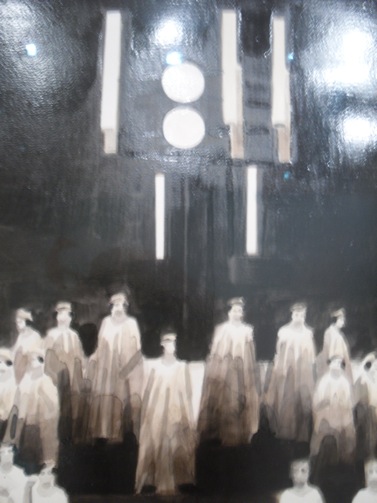
Edward Gordon Craig 1872-1966: Treasures of a theatre designer
1 'La Procession Nocturne (Liszt)', wood engraving, 1927
Edward Gordon Craig 1872-1966
Avant-garde Theatre Designer & Artist
Stage Designs & Photographs, Drawings, Engravings, Woodcuts & Etchings
Aberystwyth University School of Art Gallery
29 November - 28 January
A Monnow Valley Arts Centre touring exhibition
An exhibition crammed with a cornucopia of small prints, drawings, photographs and ephemera. Of particular interest to students of literature, theatre, stage design, printmaking and illustration.
All photographs of installation views Margaret Sharrow, 2011
2 For King Lear, 1925
3 'La Commedia', woodcut, 1911
4 'Odysseus Arrives at Crete'
5 'Ophelia'
6 Photograph of set model
7 'Weep you no more sad fountains', 1906
Review: Michael Roberts - a close encounter with the face
Detail of 'Face X', painting by Michael Roberts, copyright Michael Roberts 2010. All photographs this page by Margaret Sharrow, 2011.
Imaging the Face
PhD exhibition
Aberystwyth University School of Art Gallery
29 November - 28 January
Larger and closer than life, a series of faces loom up to the imaginary windows of a short series of canvases. This is 'Imaging the Face' by Michael Roberts, a select study of a few persons rendered in such detail and yet in a way that would make it difficult to identify them, even if they were known personally to the viewer. Roberts has been exploring this theme since his MA, slowly producing a series of paintings all titled Face and differentiated by Roman numerals. The most recent work, Face X took 18 months to complete, between 2009 and 2010.
Roberts, who describes his oeuvre as 'hyperrealist representation of the human face', has an almost scientific procedure he follows as a working method, appropriate enough for one who always works dressed in an immaculately clean white laboratory coat. The paintings originate from one digital photo, which is drawn on canvas. Roberts then reshoots details of key elements of the face using macro photography at a scale of 1:1 to 1:6, which are then the basis for painting. For Face X, he further used microscopic photography to a magnification of between twenty and four hundred times life size. This third layer of photography was presumably also taken directly from the face, rather than enlarging the first photograph. The notes on the exhibition panel suggest that details such as translucent hairs may be lit differently at different times.
It is inevitable that the work will be compared with other photorealist painters such as Chuck Close. However, while Close's famous hyper-enlargements of the 1970's were larger than most photographic reproduction technology could produce at the time, Roberts is working at a time when the only limits on printing size seem to be the width of the paper roll. Roberts emphasises the 'handmade' quality of his images, produced over the course of months, the opposite of speedy digital printing. Close's work also mimicked the limitations of the camera, particularly that of depth of field, so that features of his sitter's faces are 'in focus' while hair and clothing slightly further back in the picture plane are blurred. Roberts, in contrast, has invested features in different parts of the picture plane with equal levels of detail, detail beyond the level that could be achieved by a single photographic image encompassing the entire face. In assembling details from a mosaic of microphotographs, he has actually flattened the perspective of the face. While wide angle lenses emphasise the distance between close and distant objects, zoom lenses compress that apparent distance, making a row of buildings on a street appear to pile on top of each other. Macro lenses are essentially zoom lenses, and so a series of details of a nose shot with extreme, even mircroscopic macro lenses, when set side by side will make the nose appear more flattened against the face than we are used to, our 'normal' naked eye vision being equivalent to a 55mm camera lens, and most portrait photography shot around a familiar 80mm.
The effect of the flattening, combined with the close cropping removing all hairstyles, clothing and other signifiers of gender, social status, etc. is disconcerting. As is the detailed rendering of blemishes, bloodshot eyes, moles, even fine hairs we don't normally see. The effect is rather like staring into a magnifier makeup mirror my grandmother used to have: it had a set of glamourous lights down both sides, which could be set to 'evening' or 'day', in which case a ghoulish fluorescent green light illuminated every pore to garish proportions. Roberts is forcing us to confront the aspects of skin that we dwell on obsessively in the mirror, when it is our own skin, and yet that we politely ignore or recoil from in others. He has crafted images that are the opposite of those in Photoshop-filtered glossy magazines. The obsessive attention to detail, ironically bringing beauty to overlooked and sometimes (to put it bluntly) repulsive minutiae, is at its best when Roberts lets go a little, leaving the paint to make its own contribution to the rich texture of the human surface.
Installation views and details of paintings from the exhibition, below.
Announcing book - Exploring contemporary art: essays by Margaret Sharrow
Exploring contemporary art: essays by Margaret Sharrow
If you would be interested in purchasing a book with a selection of my art reviews (approximately forty pages, including new essays not published here), please contact me. Please state a price you think is fair, and tell me what your local currency is.
The book will be published by Gwasg Oriel Press in 2011.
I am also considering publishing some of the longer reviews individually as pamphlets, with additional educational material aimed at schools, galleries, etc. - if this idea appeals, let me know.
My current publications are available now at Gwasg Oriel Press, including the catalogue from my 2010 exhibition Shrouded forms.
Magma by Marianna Mørkøre and Rannvá Káradóttir: abstract forms in the Faroes
Installation photographs from 'Magma' by Marianna Mørkøre and Rannvá Káradóttir, 2010. Still images copyright Marianna Mørkøre and Rannvá Káradóttir, photographs by Margaret Sharrow, 2010
Marianna Mørkøre and Rannvá Káradóttir
Magma
super 8 film transferred to DVPAL
There was one thing that, for me, made it worth going to the Liverpool Biennial 2010. The fact that it was from the Nordic Pavillion at CUC (the Contemporary Urban Centre, appropriately situated on Greenland Street), will come as no surprise to those familiar with my affinity for all things circumpolar. It was the short film 'Magma', by Ravensbourne College of Design and Communication fashion studies graduate Marianna Mørkøre and London Contemporary Dance School graduate Rannvá Káradóttir: two Faroese artists who came to study in London, and who are now collectively known as Rammatik. The Faroes are a little-visited series of islands, a part of the Kingdom of Denmark dropped between Norway, Shetland and Iceland, said to be the toenail clippings of a Nordic giant. They have the remoteness of Foula, or St Kilda, but more so. Some of the remoter islands in the group have only had their remotest villages connected by road and tunnel within living memory. Green, green, bright green billiard tables of islands with jagged peaks and plunging sea cliffs, uniformly chilly all year round. Bird sanctuaries and brilliant jewel-coloured Danish houses. The island of the birds, where one might have to hole up for a week before a brilliant hour's sun transforms everything beyond compare.
Into this surreal and all-dominating landscape and weather come a series of black-clad dancers in curious long black caps, with swimming-cap chinstraps, hovering somewhere between Breton lace and bullets. They chop their blackened palms before their faces. They walk in a line up the hill, and run down in a hasty group. They stand in a pair and cross and uncross, open and close arms in staccato gestures. One lies, eyes closed, on the blackened rock, a ring of twirling hands draws back from the centre. They stare at the viewer, blankly, knowingly, slyly.
The editing is as abrupt as the choreography and the contrast between the black figures and the jagged green mountain that peers through the mist. Short shots accentuated by the dissonant soundtrack by Jens L. Thomsen. Pieces of end-of-reel flash. A figure stands alone against the hill. The synthesizers dive slowly towards bass, sliding from one tone fluidly to the next as a man grabs the grass to the side in great arm gulps, pushes up, and crablike moves towards camera. A yellow spot remains immobile at the centre of the otherwise green and black screen. It may be apparent by now that I have longed to go to the Faroes for many years. This film was far more than imaginative transport, however. It seemed not to posit an impossible relationship between the people and the landscape; instead the black-clad figures became high-speed embodiments of the geological ultraslow dance of the land itself, the magma.
Technology worship rituals: Katie Paterson and Adam Dix at Haunch of Venison, London review
Detail of painting by Adam Dix, photograph copyright Margaret Sharrow 2010
If you are visiting the Royal Academy, perhaps to see the Glasgow Boys, Treasures of Budapest, or to pop into No New Thing Under the Sun (the latter being a very interesting mixed exhibition in a room, free until 9 January 2011), take yourself out the front exit, turn right, right again, and come to the classically columned front directly behind the Royal Academy. This is Haunch of Venison, part of a series of high-end private galleries (there are also Haunches in Berlin, Zurich and New York), that sometimes acts as an overflow exhibition space for the RA (as with the excellent Earth exhibition in 2009. The quality of work in Haunch of Venison is always extremely high, and frequently much more cutting-edge than the work at the other galleries strung along Cork Street, which is what you face when you leave the gallery. The work never feels crowded in the generously sized rooms, yet it is not the ultramassive space that one finds in the Saatchi Gallery, or the Baltic in Newcastle.
Recently, there's been work by, among others, the pop artist Tom Wesselmann. But for me the real standout was an extensive series of paintings by Adam Dix and conceptual works by Katie Paterson, part of the Transmission exhibition that ran from 7 October - 6 November 2010. Perhaps they are people who, like me, was captivated by the PBS television series Cosmos hosted by Carl Sagan, with his stories of humanity's relationship with the wider universe. In effect this is Adam Dix's theme: the paintings depict humans engaged in ritual, borrowed from a range of iconographies: medieval, processional, photographs of gymnastic exercise, weddings and early television watching. But in each case the ritual is juxtaposed with an anachronistic item of technology. The bards at a Welsh eisteddfod are grouped around a microwave transmission tower. Traditionally costumed festival goers of indeterminate European origin bear satellite dishes at the end of poles instead of flowers or candles. An idealised 1950s family watch television, their ears plugged into iPod earphones, with curious white discs, or nimbuses, hovering over their heads. It is at once dislocating, slightly uncomfortable, and yet it makes sense. Are the people ritualising the technology, worshipping it as people did other things in the past, really us? Are we just as superstitious now, in a way that we imagine to be perfectly rational?
Paterson's work takes us further and further from earth. E.M.E. stands for 'Earth-Moon-Earth', an installation comprising a baby grand piano that plays itself, according to a score that can be followed from a nearby book. The music is Beethoven's Moonlight Sonata, which was translated into Morse code (which das and dits you can hear through headphones), distorted by bouncing off the surface of the moon, and beamed back, minus a large number of randomly spaced notes. This is the version that the automatic player-piano-with-electronics-not-paper-scrolls presses out, mechanically, endlessly, with odd lacunae, pauses and hesitations, and short intervals of silence just before the final cadence. Translation, mistranslation, mechanical misunderstanding. Beethoven sang an ode to the moon, and at last the moon sings it back to us. The moon appears again in a different installation, in which a single bulb hangs in an otherwise dark room, emitting light balanced not to mimic daylight, but moonlight. Nearby is a box with a lifetime's supply of such bulbs. Moonlight for life.
In a different room, a box full of slides of a potentially infinite series of photographs of space. No stars are visible (though many are pinpointed on a nearby work): a series of sample prints are all uniformly blank. They are stamped by Paterson with their edition numbers: an infinitely tiny number in a set comprising infinity. Photographing every sector of space is a project that will never finish. The physical expression of these works, i.e. what is in front of you on the wall, is less compelling than the other pieces. But the impact of the idea, which sets you free in Sagan's 'spaceship of the imagination', is far more powerful.
more images from the exhibition
Katie Paterson at Haunch of Venison website
Katie Paterson at Haunch of Venison: more images
Review: Dexter Dalwood's Turner Prize talk (thoughts on 'the Darth Vader of painting' and visual sampling)

Image: Dexter Dalwood, 'Sharon Tate's House', 1998
setting: a room, but with people
Grateful to have a place in the fully booked venue, I settled into my seat to await the start of the second of Tate Britain's series of talks by each of the artists on the Turner Prize shortlist. Having missed the Otolith Group talk on 22 October, I was able to attend the talk by Dexter Dalwood, which took place on 5 November 2010 in the Tate Britain auditorium (accessed through the Clore Gallery entrance).
The talk format was a structured but fairly informal conversation between Dalwood and Michael Bracewell, writer and critic. The latter part of the talk was accompanied by a slide projection, mainly of examples of Dalwood's work. What follows is a filling out of the more coherent parts of my notes from the talk. Direct quotations are, therefore, approximate... and sections have been rearranged, and dropped out, like the Morse code Katie Paterson sent to the moon and bounced back, minus random bits of information.
advice to students
Dalwood spoke of the need for 'an odd passion for looking at stuff to get you involved in making ... Once the light goes on there's no reverse gear from the nerdy aspect.'
Advice to students included the idea that ideally, if yourself as you were on the first day at art school was to time travel and walk into your degree show, the earlier self would be 'totally shocked and surprised'.
He spoke of having to map out a course for yourself: in his case, he went through a series of narrative paintings with figures during his BA at St Martins; a time of 'bad semi abstracts' at the RCA; and then a time when he was 'lost' and unable to paint.
He recalled advice he had from Paula Rego in a tutorial at St Martins:
'"Always be as cruel as you can." It's a good thing to think about - not blood and guts but in making, risk, push it out. For you it might be a huge revolution, for viewer they might say, "oh, it's such and such". Always be pushing up the ante. Deliberately make it hard in a way, but not to numb it. That's the only advice I remember from college.'
contexts for Dalwood's practice
Dalwood said he came to art through music, not the other way round as is perhaps more typical. Growing up he had an awakening with the advent of the Velvet Underground, a glamourous fantasy come to life. 'I was excited about the idea of the Velvet Underground. The space in New York to do with Warhol was light years from the grim Bristol existence in the 70s.'
Dalwood spoke of the A New Spirit in Painting show at the Royal Academy in 1981 where figurative painting was allowed in after being sidelined in the 1970s, of a peculiar subjective expression allowed back. Philip Guston was very important after the shift, as were Julian Schnabel and David Salle. In the mid 80s, he contended, there was a backlash against market control of success, when 'painting appeared to behave badly'. Photography, he said, then became the main postmodern form, while painting had to recarve out territory. Gerhard Richter was the main exponent - 'he became the sort of Darth Vader of painting'. In the wake of Richter everyone thought that if they were serious they would have to think conceptually, a phenomenon that was more endemic in the UK than Germany. Blurring the photo became the look, with few doing something different, though examples of divergence included Peter Doig's romantic dreamscapes, which Dalwood perceived as fresh. Generally there didn't seem to be a territory one could occupy in painting, when there seemed few acceptable avenues to pursue.
Things have changed a great deal, Dalwood said, since the time when a great cultural weight was given to abstraction, which 'feels like a hundred years ago'. He cited the example of the 'incredible hubris' of Clyfford Still, who famously remarked that when his paintings landed in France you could feel tremours all the way to the Kremlin. So when Dalwood decided to use one of Still's paintings as an element in his painting to represent the peeling wall of a swimming pool ('Brian Jones' Swimming Pool', 2000), he felt it would evoke pathos.

Image: Dexter Dalwood, 'Brian Jones' Swimming Pool', 2000
on the art historical references in the paintings
When asked how important it was to him that the viewer knows the references, especially the younger viewer, or one from a different culture, Dalwood emphasised that the paintings are not a checklist. The Tate St Ives show for which he was nominated for the Turner Prize was the first show with titles of the paintings on the wall. In Dalwood's commercial shows the viewer sees the painting first, then the title on the printed list supplied by the gallery. It is an important point: Dalwood has chosen not to provide the viewer with signage, because he wants the viewer first to see the work as paintings, as images, and second to read the title, and thirdly to make further meanings. He sees the paintings as being like 'pebbles that make ripples that keep going' or as 'an irritant to the viewer' because they might have their own image of what a particular famous room might look like, and discover that Dalwood's painting is 'nothing like my version, like the novel compared to its adaptation into film'.
on Dalwood's working methods
Dalwood starts work on a painting with sketchy pencil drawings which may have a bit of a collage element added, then moves on to make a collage, quite a small one (smaller than A4 or 8" x 11"). The transition from collage to painting is 'where it all happens'. He is not interested in translating the collage in a photographic way into a painting, but in how the collage acts as a springboard that lets him invent. The excitement for him is 'how I do the lamp for an 8x6 foot canvas, not replicating the photo'.
He has become interested in how to use flat colour, how colour in itself is a powerful element in painting. Dalwood had a one year scholarship to India during which he studied miniature paintings, which fascinated him as examples of how to set up a theme or mood with one colour, a technique he has adopted into his own work (look at the expanses of colour, for example the carpet, brick wall and massive ceiling light in 'Sharon Tate's House', 1998).
on sampling
Dalwood says he is at ease with the concept of sampling in painting, a visual equivalent of music sampling. David Salle chopped up elements in his paintings with no hierarchy, but we are well past that now, Dalwood contends. 'It's how we construct our lives. It's easy for me to use quotes from different things as a language with some energy if the things are more than the sum of its parts. If I'm editing I ask, why would that work? Is it too corny, too obvious? Painting will have an odd quietness where you find a moment when it settles and functions as a painting.'
He began to think about collage elements on the surface of the painting. 'Robert Rauschenberg's Bed was the most alarming painting I could imagine making and putting in a gallery.' Made in 1955, this 'bed with paint' made Dalwood see him as 'a giant... a leading postmodernist exponent, along with de Kooning'. He struggled with how to include collage without it being arbitrary but part of the fabric of the painting.
'If you were in a prison cell and given two magazines a week you could construct a whole other world from just that plus what you think of.'
'We sample stuff in our heads - books, films we haven't seen - yet I could tell you about them. I feel totally easy about it; it's a valid thing to do. But it took a long time to get to that point. You have to do what's right for you. At art school I was asked "Why do you put things together so awkwardly?" Perhaps awkwardly is the point of the work. What you do naturally odd - there may be a reason for it.'
Notice of the talk on Tate Britain website
Documentary of Dalwood shown at 2010 Turner Prize exhibition
Turner Prize 2010 review: Tate Britain's apples & oranges annual
Installation view of Otolith Group at the Turner Prize exhibition, 2010. Image copyright Margaret Sharrow, 2010
As always, the Turner Prize seems to offer comparisons between apples and oranges - a difficult task to compare diverse work in different media. This year the visitor sees, starting at the exhibition entrance and walking straight through, paintings by Dexter Dalwood, film and video installations by the Otolith Group, sculptural paintings and sculpture by Angela de la Cruz, and sound art by Susan Philipsz.
It helps to know that what is actually being compared is not the work on show, but the exhibitions (elsewhere) for which the artists were nominated. As I've only seen Dexter Dalwood's show at Tate St Ives, I can't offer any perspective on whose exhibition most brings out the qualities of the work of the particular artist/s, or how the exhibitions compare with other exhibitions by the same artists, all salient points for the Turner Prize committee. The public, aside from those priveleged and dedicated enough to travel round the UK and Europe seeing exhibitions with persistence and prescience, are left to compare what is actually on show, and to browse the catalogues of the artists' work displayed outside the exhibition. As the natures of the prize and the exhibition are constantly evolving, in future it might be an idea to show, either through photographs or video, the exhibitions for which the nominations were made. This would be a great contribution to the Turner Prize exhibition, and would allow the public to make a more informed comparison - as most people naturally assume that what they see in the exhibition is the basis for awarding the prize, when it is not.
In Susan Philipsz's case, the location of the sound art is particularly relevant to appreciating the full impact of the piece; the acoustics of the Clyde bridges in Glasgow are surely completely different to that offered by an exhibition room in the Tate. However I can say, without any use of the imagination, that the impression made by Dexter Dalwood's paintings in St Ives is somewhat different from that in London. It is not just the surroundings, stepping off Porthmeor Beach as opposed to a rainy day by the Thames, or even the difference in architecture, the classical square forms of Tate Britain differing from the partly rounded forms of Tate St Ives, with the main atrium fronted by a wall of curved glass overlooking the beach. The St Ives exhibition consisted of far more paintings, four rooms full, spanning work from the 1990's to pieces completed in 2009, months or possibly weeks before the exhibition was mounted, so there was a sense of continuity and development, from early pieces representing interior spaces, to the first ones that utilised overt references to other painters, to recent pieces such as The Death of David Kelly (2008) that are more simplified. In addition, Dalwood was persuaded by the St Ives curators to hang a series of small paper collages that are an intermediate preparatory stage crucial to his work. These were a striking display in the sea-facing rotunda, and provided a fascinating insight into his working process. It was possible to compare collages with their subsequent paintings, and to see which elements were altered, resized, recoloured, substituted, or, like the figure on the staircase in the Mandelay painting (2009), removed entirely. Finally, Dalwood had curated an exhibition of work from the Tate collection, with a common theme of work produced in 1971, which was shown in the lower gallery, visible from the area containing the collages. I'm uncertain as to whether this exhibition 'counts' as part of Dalwood's Turner Prize nomination, but it would certainly have been held in the minds of many visitors as they absorbed Dalwood's paintings upstairs. Dalwood's choice of the year 1971 as a common theme is a personal one, as it was a significant year in his childhood (we are not told why) when he was living in nearby Penzance. A record album design sits alongside work by Picasso (both are typical of sources he has 'collaged' into his paintings). Significantly, there is a maquette of a sculpture by his uncle, the sculptor Hubert Dalwood. The elder Dalwood's striking work, as seen in a catalogue in the public reading room, may have been both an inspiration and a burden to live up to. The 1971 exhibition was certainly very informative as to the cultural climate from which the younger Dalwood emerged (even if he didn't see these particular pieces at the time), and thus provides a different level of reading for the exhibition of his paintings.
I can only speculate as to the layers of context and meaning provided by the unseen previous exhibitions by the other artists nominated for the 2010 Turner Prize: it is well at least to be aware that there is a great deal more to the Turner Prize than meets the eye.
The Turner Prize is awarded on the evening of 6 December 2010, live on Channel 4
Turner Prize 2010 exhibition continues at Tate Britain until 3 January 2011
Tate Britain Turner Prize link
Tate St Ives Dexter Dalwood exhibition guide link
Adrian Serle's review in the Guardian
Please vote for me to become the official blogger / artist for an expedition to the North Pole!
Rachel Whiteread Drawings: studies in negative spaces, places for play - Tate Britain 8 September 2010 - 16 January 2011
Photo: Rachel Whiteread video on display in main foyer, Tate Britain, to accompany her exhibition. Photo copyright Margaret Sharrow, 2010; video copyright Tate
It's always interesting to see artists' preparatory work (see Francis Alÿs, 'A Story of Deception'), and this selection of drawings, photographs, maquettes and items from the studio of former Turner Prize winner Rachel Whiteread makes a nice complement to the current year's contenders' exhibition. There are many drawings made on graph paper, and I began to wonder what benefits this might offer her (scaling up? guidance against a tendency to stray from the straight line?), and why I hadn't tried drawing on graph paper myself. She is also fond of using whiteout as a drawing tool, something Michael Landy has used to great effect in some of his drawings of Tinguely's Homage to New York.
As a photographer it is always interesting for me to see what use non-photographer artists make of this medium. There was one photograph of an urban landscape, a study for her water tower piece I think, that she had painted over, giving a very atmospheric result. Other photographs were daubed with whiteout to indicate the negative spaces that are the hallmark of her sculptural work. (The idea of highlighting the negative space, the invisible thing in preference to the apparently existing things, is one that appeals to me greatly.) There is the famous house, blotted out while its neighbours remain. There is another photograph of the field, after the standing guts of the house that was Whiteread's seminal work had been demolished by an anxious council. An absence of an absence. Perhaps we should be visiting this ghost of a work that was a ghost of a house.
I also liked her plans for the fourth plinth in London's Trafalgar Square - to have the mirror image of the plinth stood on top of itself, made of some translucent material. 'Do it! DO IT!!!' I shouted to her, though she wasn't there. Fortunately I did all this shouting in my head, or they would have thrown me out before I could have seen some of the most interesting work: studies on modified postcards (one filled with negative spaces through the aegis of a range of differently sized hole punches), and a vast array of handholdable (but sadly safe behind glass) treasures she keeps in her studio: glass globes and crystal balls, a mould of Peter Sellers' nose that was a sample from a sculptural materials company, single shoes, toys, stones, resin moulds of bowls, mirrors and other delightfully reflective surfaces. Such is the stuff we need to have about us, for reference, for inspiration, for play. For it is play that allows us to connect with the unfettered, uncluttered self that can create with clarity.
A bonus exhibition that can be seen on a combination ticket with Eadweard Muybridge and the Turner Prize.
Rachel Whiteread Drawings continues at Tate Britain, London, until 16 January 2011
Posted 9 November 2010
Review: Francis Alÿs and 'A Story of Deception' - narrative readings

If you haven't seen Francis Alÿs' retrospective 'A Story of Deception' at Tate Modern, you're too late. It closed on 5th September, and in my non-journalistic style, I am only getting round to the review now. However, it will be showing from October at WIELS in Brussels, and from May at the Museum of Modern Art in New York, with some differences no doubt, partly due to the architecture in the respective venues. For the arrangement in space of this exhibition is as important as the individual works themselves. It is this narrative reading of Alÿs' exhibition that I would like to consider in the first half of this review. Visitors who like to be surprised by what they see in a gallery, and how it is presented, should hasten to the second half of this article, in which I consider a way of reading Alÿs' oeuvre as having spiritual themes, concurrently with the more widely discussed political themes. Although it is impossible not to interweave some of my readings of these spiritual themes in with the discussion of the narrative; as Alÿs has said in another context, it is impossible to dissociate the one from the other. ['Meet the Artist: Francis Alys', Tateshots 30 april 2007, on the process of the production of the work inextricably linked with the final product]
A Story of Deception: Narrative in exhibition
This is intellectually stylish stuff, both the individual works themselves, and their visual/narrative presentation, on whatever level you choose to take them. Prepare yourself for a treat, whether remembering or anticipating.
Introductory text panel
A Story of Deception (16mm film and slashed painting)
Sound audible in room: the whirr and click of a 16mm projector
Lighting: moderate
Most visitors tend to bunch up at the initial explanatory panel at exhibitions, which in this case is on the wall behind you as you enter. What confronts you face on is, I think, what Alÿs wants you to see first, and focus on: the looped projection of an ever approaching, and ever receding, mirage filmed while prone on the bonnet (hood) of a car trundling slowly along the eternally straight highways of Patagonia. The heat rising from the land, as well as the softening quality of 16mm film, renders everything slightly out of focus, a dream like quality, punctuated every minute or so by flashes of light produced by bands of dark frames where the film is spliced, creating a loop. Alÿs may well be saying with this piece, 'Here I am, this is what I do, come into the dream with me, the metaphor of the mirage as the eternally unreachable notion of progress in Latin America. I will be speaking to you throughout in dreams and fables, and all is not what it may seem. When you think you have grasped my meaning it may well prove to be just an illusion. Come deeper, and I will show you more.'
Already what I might describe as the intertextuality of this exhibition is at play here; at all times Alÿs is placing one work juxtaposed with another, perhaps made years earlier or later, and often picking up themes of other works not included in the exhibition but often referenced in the catalogue. So the blinding flash of light at the beginning and end of A Story of Deception foreshadows the sudden eclipse of nothingness that overcomes Alÿs and his camera as he plunges into the heart of a tornado, in Tornado at the climax of the exhibition.
Possibly unnoticed, in one's peripheral vision if standing behind the projector, is the other half of A Story of Deception - a small canvas depicting the afterglow of a pink-lit sunset, vertically slashed completely in half, wood frame and all, the blade having hollowed a groove out of the gallery wall. (I can't help picturing a technician having a fun time with a rotary saw.) The vision is not just illusory, but negated, expectations of wholeness literally torn in two. The exhibition, despite the best efforts of the curators and the insurers, is not to be precious or behind glass (though most of the ephemera are).
The Loop (postcards and text panel)
When I'm Walking (powder on twin panels)
The globe (globe and elastic band)
Sound: 16mm projector, slide projector, bell tolling, occasional insistently rung handbell
Lighting: moderate
The state of fable and dream being established, the visitor rounds the corner to be confronted with a work that exists only as a description, a fable: Alÿs' participation in the 1997 exhibition InSite consisted of The Loop, in which he travelled for twenty-nine days round the Pacific rim in order to avoid crossing the US border between the adjacent border towns of Tijuana and San Diego. Maximum effort, minimum result, as one of his maxims goes (I can picture the scene at the travel agents' in Tijuana: 'But the tram stop is just over there - you can get to San Diego for $2.80!'). No video, no ephemera, just a stack of postcards with a map and a picture of the Pacific. Take one, visitor, and you have a work from this exhibition as valid as any of the paintings from Alÿs' collaborations with the Rotulistas (not exhibited), whose market value soared beyond the pockets of their producers despite the intention of saturating the market.
The eye is drawn to When I'm Walking, a credo of methodology in blue powder, used when stencilling the outline of the shushing finger of the Silencio motif over the walls of Panama City. Alÿs might be saying, 'You have now my themes of fables, unfulfilled dreams and politics - here then is one of my favourite methods of working explained, the walk, so simple compared to the endless global travel demanded by the art world.'
The quiet of the gallery is finished, for the cacophony of noise draws you swiftly on to Room 3 - indeed you inevitably glimpse Ambulantes, showing people doing a very different kind of walk, through the door while looking at While I'm Walking.
Ambulantes (two slide projectors at floor level)
Paradox of Praxis (video projection)
Patriotic Tales (large video projection)
The Collector (objects and video)
Lynchados (paintings and ephemera)
Historic centre, Mexico City (drawing)
Sound: bell tolling, occasional insistently rung handbell, occasional siren, Tijuana brass band, soprano singing German lied intermittently, accompanied by piano, voiceover in Spanish
Moderate lighting, dark in Patriotic Tales seating area, the other side of The Collector, which forms a see-through barrier. Ephemera are displayed on a long glowing lightbox.
The next few rooms burst on the visitor with an overwhelming barrage of sound and ever-changing vision. It is an excellent simulation of the effect of suddenly being dropped in the middle of a very large, crowded foreign city - and this one can only be Mexico City. It is of course a metaphor for Alÿs' own experience, the experience of anyone who comes to a point in their life where they are transplanted to a completely different society on the other side of the globe. How to make sense of it all? In the room, most people will either start by investigating Ambulantes, a double slide projection of photographs of street sellers moving their goods in various ingenious ways without benefit of forklifts (a nice complement to the August Sander-inspired typologies currently on display on another floor of Tate Modern) - or the visitor will be drawn to the clamour of Paradox of Praxis, a video of Alÿs pushing a block of ice through the city for nine hours until it completely melts. These two works, so different in tone, have rather obvious points of comparison, as the non-motorised locomotion of trade in a place with terminally delayed modernity. Alÿs, of course, is not selling the ice, though he is, in a sense, selling the documentation of its demise. Is this right, or comfortable, we might wonder, when the people in Ambulantes are pushing awkward objects for real, so to speak, because they have to, to survive? The artist's survival is equally precarious, and an artist's work itself may be on the surface more difficult to justify, from a 'modern' society's point of view - if the production of the artist is something that is deemed either unnecessary, or in this case, if no object remains for the art market after the effort. The right of the artist to work in a way that could be seen as a parody of the work of the ambulantes may also be challenged particularly when the artist is in some ways the eternal outsider, even after years of being part of the local furniture, so to speak - though I believe Alys' sympathies to lie entirely with the ambulantes, and the joke to fall entirely on himself, as he doubles over to carry the precious ice down some steps. (Most visitors were watching with serious attention and I was relieved to spot at least one other person helplessly chuckling.) All the issues raised by the juxtaposition of these two works are themselves references to Turista, an action that took place a couple of years after Alÿs began collecting photos for Ambulantes, in which he spent a day standing behind a sign offering his services as a tourist, alongside others touting for work as electricians, plumbers, etc.
Another point of intertextuality of Alÿs' oeuvre in the narrative of this exhibition: Ambulantes is projected at floor level, so that the viewer, even the child viewer, is looking down on the people in the photographs. This positioning problematises the viewer-subject relationship in the same way as Beggars, not exhibited here, but shot from above and always projected onto the floor to replicate the positioning of the viewer.
Alÿs continues to say, 'So this is Mexico City, where I have practiced most of my walking - these are the streets, the people, the politics' as you are inevitably drawn to the loudest piece in the room, Patriotic Tales, a mainly black and white video projection filling the entire wall of Room 4, partially glimpsed through open metal shelving that marks the boundary of Room 3, on which are displayed about fifty of Alÿs' magnetised metal dogs on roller skate wheels, and the video for their project, The Collector. At first you are looking through the dogs to see sheep - for Patriotic Tales is the documentation of Alÿs walking a series of sheep around the enormous flagpole in Mexico City's Zócalo square, in homage to the 1968 protests of civil servants in that place. Here is another kind of walk, but destinationless, going nowhere, and therefore as 'unproductive' as dragging a block of ice around, or indeed as the labour of those of the ambulantes who manage to sell little or nothing after their huge efforts. A loop, but a much smaller one, with a more specific target for its commentary. It is hard, watching, not to marvel at how the sheep continue to walk assuredly in the established circle, especially once they are being called out of the circle one by one, leaving a growing gap behind Alÿs. The animal choreography and performance of this single take is flawless, and the viewer becomes hypnotised by the ever changing yet predictable pattern of sheep, and the regular, endless tolling of the bell. This tolling takes on a new significance if, upon emerging from Room 4, one looks at the tiny painting Lynchings (Linchados), dwarfed by a long light box of ephemera, including materials relating to this phenomenon of people seeking 'justice' against accused community outsiders, in frustration at the perceived failures of the Mexican legal system. The bell tolls endlessly, for these dozens of victims, as it tolls too for the frustrations of hundreds of civil servants, for the wasted efforts of thousands of ambulantes. For us who laugh with Alÿs, seeing in his struggles with the ice a metaphor for our own hapless tilting at online forms that freeze, call centre menus that lead to no human voice, or jobs that seem to make no difference in the world, there is only the clanging of a handbell to signal us to start all over again, and the laughter of children at the inevitable end.
Finally, in a neat piece of circularity, the visitor might tear their eyes from the larger screens and see a fourteen-inch monitor with most of the colour drained from it, depicting Alÿs in a nightly perambulation with The Collector. This screen is at dog height, so that the best way to see it is to sit down on the bare floor, at the level of the Ambulantes. While it is impossible to see what magnetised detritus the dog might be collecting, instead what the viewer collects is more glimpses of Mexico City: late night lights of tiny shops and bars, rubbish sweepers, a street seller with a cart that lets off a dramatic blast of steam, rubbish, rubbish, rubbish, and a drunk leaning against a post. Like the metal dog, you have been rapidly collecting impressions of Mexico City, and one more remains: upon leaving the room, you might notice an architectural drawing of the historic centre, a surprisingly straight grid belying the apparent chaos of the dog's wandering through tumbled backstreets.
Re-enactments (video projection and ephemera)
Sound: bell tolling, occasional sirens, occasional insistently rung handbell, slide projector, German lied, commentary, Tijuana brass band, roar of car engine
Lighting: subdued. The ephemera are displayed on a long lightbox.
The sense of chaos and possible danger intensifies as this room confronts the visitor with a double video projection of Alÿs' walk through the city with a loaded gun. Alÿs has expressed regret at allowing this representation to reinforce the stereotype of Mexican urban violence; however from the ephemera displayed, it is obvious that the media there focus on the gangs. I also cannot believe that those in the population who can afford satellite television, or who live close to the US border, are not exposed to police documentaries featuring the very type of re-enactment Alÿs presents here - complete in its details of unrealistic dramatic closeups, police and public as 'actors' playing themselves, and the sudden point of view shot as Alÿs is bundled into the police car. Certainly the meticulous storyboarding displayed with the ephemera does a lot to unpack the contrived 'reality' of such programmes. I also don't think that the piece necessarily highlights incompetence in the Mexican police: the timecode on the tape of the original action, though condensed by editing, appeared to roll for only twelve minutes from the time he left the shop with the gun. It depends where you are, I suppose, but I think twelve minutes is a pretty good police response time.
But returning to consideration of narrative in the exhibition: one continues being immersed in the physicality of Mexico City (shops with shutters drawn, a man carrying a cello), while considering the political and social milieu. 'This is how it is here now,' Alÿs seems to be saying. 'Now come into the next room and I will show you the mechanics of it, and how it came to be this way.'
Room 6
Politics of Rehearsal (video on television, small projection and ephemera)
dog fetching ball (video on laptop)
Caracoles (video projection of boy and bottle)
La Leçon de Musique (painting of two men blowing on paper)
Sound: more chaos of (German, European) piano and song versus (Latin American) Tijuana brass band, roaring car engine and sporadic handbell, with occasional sirens and constant speech with intermittent additional Latin American music from documentary in Room 8
Lighting: subdued, mainly from projection screens and light boxes with a few spotlights on the painting
The mechanics behind the current Mexico, where ambulantes and civil servants alike struggle, where garbage lines the streets every night and where anyone can buy a gun and walk down the street with it, Alÿs suggests, began with Harry Truman's inaugural speech in 1949, in which he positioned the United States as prosperous and progressive, and said that the way to safeguard this prosperity was to recognise Latin America as undeveloped, and to give aid so that they could embrace modernity. This speech opens the video Politics of Rehearsal. However, Alÿs suggests through the voice of commentator Cuauhtémoc Medina, in order for the United States to remain prosperous and to keep the upper hand, this modernity must be forever delayed. This room is full of metaphors for the delay: the rehearsal, in which a song is never sung straight through, and a stripper stops her act and begins to dress again every time the musicians pause; the dog who endlessly fetches a ball, eager for reward but only to have the ball thrown away again; the papers that are endlessly ruffled in a third projection, or blown to a fragile and pointless verticality in the painting; the circle of men who draw on each other's backs, a sort of Ouroboros of eternal labour; the boy who is determined to kick a bottle up a hill, even though it will always fall down again.
Rehearsal I (El Ensayo) (maquette version, video projection)
Rehearsal I (large video projection)
Sound: very loud Tijuana brass band, still louder gunning of a hapless VW engine
Lighting: the interior of this room is dark, lit only by the projection screen
Never one to shy away from reworking an idea again and again, here Alÿs presents the musical rehearsal and the bottle rolled into one. There were always people watching these videos, laughing as the jaunty red car failed yet again to ascend the Tijuana hill, or make it to the US border beyond. The rules were as with Politics of Rehearsal: when the music rehearsal stopped, the progress of the car stopped. Of course Alÿs was controlling not only the car, but also the brass band: explaining his ideas for a composition without a score or musical terminology, a hundred pauses and reworkings were inevitable. The use of music of his own composition will be echoed in Room 16, and in the extract of Bolero (Shoeshine blues) playing in the documentary shown outside the exhibition.
When Faith Moves Mountains (large video projection)
Sound: diegetic speech, soundtrack music, with intrusions from the car and brass band from Room 7
Lighting: Dark except for projection screen and light spilling in from the doorway of the next room
Our artist guide might well continue, 'Well, if eternally delayed modernity is the mirage resulting in the chaos and poverty shown in Rooms 3 to 5, what can we do about it? However absurd it seems, faith can literally move mountains!' One of the most popular pieces in the exhibition, it was apparent in this 'making of' documentary that the Peruvian student volunteers for this intervention on a grand scale found the experience of shoveling sand up one side and down the other of a massive dune an overwhelmingly uplifting one. While initially treating it as some kind of bad joke ('A Mexican, a Belgian and a tutor walked into the union bar... I said, "Don't they have sand dunes in Mexico?"'), afterwards participants spoke of being made to 'think' when they saw the shanty towns near the dunes; of the elation at coming over the ridge and seeing the view; of the euphoria of physical activity and communal spirit ('I felt really great!'). And, as so often with Alÿs' work, it immediately became the stuff of fable, tales to be passed down to next year's freshers; dreams of 'future projects' they might do: 'Drink the Atlantic, melt the Antarctic, paint the sky... simple things like that!'
Silencio (array of rubber mats filling the floor)
Sound: Not silent! as the speech and music from When Faith Moves Mountains spills in, though people tended not to talk in this room, often walking through the shortest possible route on tiptoe in case they weren't allowed to walk on the artworks
Light: optimistic, with natural light from a large window, subdued by a translucent shade, supplemented by bright artificial light
As you salsa your way out of Room 8 (an exuberant chorus of 'Si! Si! Si!' plays out the credits) you are confronted by a floor of rubber mats, each bearing a differently coloured finger raised to lips, but no verbal explanation. Only diligent reading of books other than the Tate catalogue, or a sharp eye for some tiny print in the foyer outside the exhibition, might hint that Alÿs went to Panama trying to spread a minute's silence, rumour style (One Minute of Silence, 1993). But the message, in this room filled with more light than any so far, seemed to be getting through; aside from the noise of the soundtrack from Room 8, there wasn't much conversation here. 'I want one of these for my front door!' cried a woman, laughing at the prospect of finally being able to silence noisy family and friends.
Room 10 (corridor)
Sandcastles (video screen embedded in wall)
Déjà vu 1 (small painting under glass)
Sound: waves and spades on sand, commentary from The Green Line, speech and music from When Faith Moves Mountains
Lighting: dim, lit entirely by light spilling in from adjacent rooms
A miniature version of When Faith Moves Mountains, and shown on a smaller screen. Except this little mountain was hopeless; it would inevitably be washed away, despite the diligent efforts of the boys who built it. But that was the whole point; a game, just as the stones that will be so earnestly skipped in Room 12. Perhaps taking things as a game, or at least poetically, is the best answer to the deferred mirage of progress. It was mainly the children who enjoyed walking on the Silencio mats, without fear of damaging valuable art work.
Room 11
inner room:
The Green Line (Sometimes doing something poetic can become political and sometimes doing something political can become poetic) (large video projection and laptop with map and commentary menu)
Sound: the voices of the commentary
Light: lit only by the screens
outer room:
The Green Line (text panels, maps, ephemera)
Camguns
Small paintings of Israeli landscapes
Sound: the commentaries
Light: ample natural light from large windows, with a view of the Thames and St Paul's Cathedral
'Now, as the outsider showing you Mexico from the inside, I move you to just one of the many places round the world where I work in my guise as an international artist. Behold the situation in Israel and Palestine: so entrenched and seemingly intractable; so absurd when a grease pencil draws a line on the map that is actually sixty metres wide when scaled up. So here I will show you how I made a 1:1 map, by doing another walk, this time with a can of leaking green paint. And just as I have shown you that the video or painting is the tail wagged by the dog of sketches and ephemera and a long, vibrant process of creation, here I will show you a variety of commentaries and critiques of my work, results of my work seen while viewing the work itself.'
This last is actually very clever: by interviewing around a dozen people with varying points of view on the conflict and the work, and playing them as a rotating soundtrack to the video of himself doing the walk, Alÿs created a captive audience who were willing to stay to see the video several times. The commentators were listed on the laptop, and changed automatically if no one selected a particular name. Meanwhile an animated map traced Alÿs' route as he walked it while the reactions of passerby were juxtaposed with both Alÿs' progress and the commentaries.
Camguns: here we come to the inevitable device signalling 'this is precious: do not touch' - the little rope slung across the corner, gamely protecting the assemblage of Camguns, made from found film reels and assorted junk, emblems of violence, or a kind of media violence, or the possibility of tempering violence through photographic / artistic intervention. What good is this rope really doing, aside from providing a distraction from the work? I wonder if it was some sort of compromise; at Tate St Ives they have these strips on the floor that emit a guilt-inducing wail whenever anyone looks too closely at a painting. The Camguns, though no doubt valuable, are also pretty robust. Alÿs is doing his best to bring the life of the studio into this exhibition, with the lightboxes of sketches, and the Le Temps du sommeil paintings with hi-top sneaker prints where the artist has stepped on the work. Reality in most studios is that things get chucked around, certainly not treated with the white-gloved hagiographic reverence they do once entering the gallery. Speaking of playing, and chucking things around, it might be time for the next room...
Room 12
Children's games (large video projection, replacing Retouque/painting)
Sound: relatively quiet, stones on water
Light: dark except for light from projector screen and natural light from adjacent rooms pouring through two open doorways
I wonder what technical, copyright or artistic decision caused the substitution of this video, after the exhibition booklets were printed. Retoque/painting, in which Alÿs repainted sixty road stripes in the former Panama Canal Zone, would have continued the theme of borders after The Green Line; instead the video of Moroccan boys skipping stones provides an intellectual rest after concentration on the varying points of view in the Green Line commentary. At any rate, there were always a few people seeking quiet refuge in here. This video continues the theme of loop; it is seamlessly cut from top to tail with no title or credits, so that I watched for a good ten minutes before realising I must have seen it all (the piece is only a few minutes long). Another little joke or mental displacement, like Déjà vu or the 'looking up' globe in Room 2. Of course it is really only the post-medieval/Renaissance Western culture that sees time almost exclusively as linear progress rather than circularity, something Alÿs would have encountered in his studies of medieval urbanism. This circularity gives a dreamlike quality which leads on nicely to the next room.

Le Temps du sommeil (dozens of small paintings arranged around the corner of two adjacent walls)
Sound: intermittent roar of tornadoes
Light: well lit by large windows
One half of this room is empty, or occupied by windows. The other half contains a little snake of people making their way from left to right along this collection of very private dream-like paintings, often produced late at night. The whole collection may suggest some kind of narrative, at least the sort of nonsensical narrative with erratic changes of scene typical of dreams. Besuited figures performing mysterious acts on grassy moonlit swards, glimpsed through an ochre haze that is itself torn with incised drawings and date stamps. And of course, the occasional footprint. 'When the problems of politics are too big, and poetry and even play fail you, it is best to fall back into the subconscious and dream. Perhaps a solution will emerge.'
As you leave the room, there in the darkened passageway is a painting of a man skipping into a puddle. Was there one like it somewhere else? It's Déjà vu.
'And consider, visitor: have you seen what you think you have seen? And does it mean what it at first appears?'

Room 14
Tornado (large video projection)
Déjà vu 2 (hallway outside projection room)
Sound: a huge dynamic range from the video, ranging from silence to quiet breathing, pounding footsteps and ragged breath, to roaring winds off the scale of the microphone's recording range. During the quiet times a distant siren can occasionally be heard, not ambient to the location of this film, but coming through the wall from Re-enactment on the other side of the exhibition
Light: only from the wall-size projection in this windowless room with no window in the corridor outside
If I say too much about what a possible dream solution might be, I will stray into my topic for the second part of this review. I can only say that whatever intellectualising may be going on in the room that follows this one, all thought was absent in the sheer intensity of this experience - and that is just for the viewers, never mind Alÿs.
Tornado / 'situaciòn dada' (ephemera and small paintings)
Sound: quiet punctuated by the periodic roaring of the tornadoes
Light: well lit by natural light from large windows or overhead lights during late openings
A return to the intellectual, and the ephemeral. A collection of small paintings, newspaper articles, post it notes and even a spoon (shades of the catalogue photograph from the early work Péchés de jeunesse, featuring a girl with a spoon hanging from the end of her nose?). All dealing with - ways of accepting the inevitable. More on this in Part 2 of my review, but acceptance may be part of Alÿs' possible proposed answer.
Room 16
Song for Lupita (Mañana, Mañana) (small 16mm film projection and 45 rpm single on record player)
Sound: whirr of the projector, crackle of the needle in the groove of the record, and of course the lullaby repetition of the woman's voice in the song, and the guitar accompaniment. A sudden rush of crowd noise when the exit door is opened.
Light: very subdued, only from the projector and natural light spilling in through the open doorway from the previous room
A delicately drawn animation shows a woman pouring water endlessly from one glass into another, and back again. A circle, and the path through the exhibition has come full circle. Time to sit in the dark corner on the leather sofa, or to be hypnotised by the song and the motion of the record player (who has 45's any more, or anything to play them on?). 'If modernity is a mirage, time is a circle and activities lead to nothing when the ice melts and the sand dune blows back and the song is never completed, then just go with it. Relax and accept. And when you're ready, exit through the gift shop. But you won't find any of my postcards there - you've already had one, my gift to you.'
It does well to be grateful. Not just for the postcard and the work, but for the way it is presented. How much more imaginative than the chronological approach so typical of retrospectives. And how much in keeping with Alÿs' style of working, where multiple projects are developed concurrently over overlapping durations of years, giving critical distance as he flits between projects during the course of a day, and where he examines all items in his oeuvre in relation to each other, looking for gaps in an overall lifetime narrative.
Exit foyer
documentary (video on widescreen tv)
Just as you emerge, blinking and a little overwhelmed from a full dose of Alÿs, there is the possibility to experience a little more, over coffee, as a sort of appendix. The video was actually a very good thing to come back to after a meal and a stroll along the Thames; it features interviews with many people who know or collaborate with Alÿs, including a very engaging mariachi musician, as well as extracts from some of his works not included in this exhibition, such as Railings, Barrenderos, If You Are a Typical Spectator What You Are Really Doing Is Waiting for the Accident to Happen and Bolero (Shoeshine Blues).
Gift shop (Alÿs-related items)
- A Story of Deception catalogue
exhibition posters (sold out)
- Fabiola book (documenting Alÿs' exhibition at the National Portrait Gallery and other venues)
- DVD of the documentary playing in the foyer (sold out by the last weekend)
- tornado watching book
- a few books of philosophy
- no further merchandise (the merchandise related to Exposed, the other Tate exhibition, was endless)
I wonder whether the comparative lack of merchandise was also at Alÿs' direction. It would be in keeping with his and critic/collaborator Medina's concerns about the art world moving ever closer to the world of entertainment, and with his (failed) attempts to saturate the market with copies of his paintings in order to keep the prices low ['Meet the Arist: Francis Alÿs', Tateshots 30 April 2007, and Rotulistas, 1993-97].
The Nightwatch (bank of 16 televisions playing 16 CCTV videos)
summaries of actions (small stencilled labels running along wall)
The videos, recording the capers of a fox released in the National Portrait Gallery in London, was a taster for the exhibition, something to observe while queuing for admittance, or a background to coffee and cakes afterward. It was also nice to have a work that people who could not afford tickets or membership could see for free. People really enjoyed looking for the fox; one woman jumped up and down with glee, squealing, 'I saw the fox, I saw the fox!' Not just little hops; these were full, joyful, heels-smacking-the-bum jumps.
Some final thoughts on the exhibition narrative:
When moving through this exhibition, it was very difficult to backtrack and visit early rooms for comparison with the later, because of the bottleneck at When Faith Moves Mountains. Really the visitor was being forced into a linear, or rather circular, narrative; the pattern of rooms formed a loop, when the same space has previously been more open, as with the Vorticists or Cildo Meireles. I don't know if this was Alÿs' intention (to prevent backtracking through a bottleneck; the linear / intertextual narrative almost certainly was), or if anyone could have foreseen the crowds towards the end of the exhibition's run. Usually late night Friday openings means having the rooms to yourself: I found it so at Arshile Gorky at Tate Modern, and even Picasso at Tate Liverpool, both earlier this year. But Alÿs was packing them in, and they were staying for hours. The sofa in front of Politics of Rehearsal was crowded with men ('I'm appreciating art! Honest!'), twenty feet of leather sofa was continuously occupied and the doors nearly blocked with people standing to see When Faith Moves Mountains, it could be hard to elbow your way into the slow moving line 'reading' the series of Le Temps du sommeil, and as for The Green Line! It would have taken white-gloved Japanese train conductors to shoehorn more people into the room. They sat on all the seats, and on the floor, and leaned on the low wall that fed along the entranceway, and stood in the entranceway, peering over each other to read the subtitles. One expects great crowds at blockbusters such as Van Gogh at the Royal Academy, also earlier this year. But a solo show by a living contemporary artist? Maybe I don't get out enough, but I've never seen such crowds, so engaged for so long, come to see the work of someone who has a long and happy career still ahead.
As the Tate catalogue says, we look forward to Alÿs presenting himself again. [Vicente Todolí, p. 6]
on to part 2: A Story of Deception: A Spiritual Reading
back to blog home
Francis Alys' website
Tate Modern, London
The exhibition continues at WIELS, Brussels from 9 October to 30 January 2011
then travels to MOMA New York from 8 May to 1 August 2011
All image sources copyright Francis Alÿs, and rephotographed by Margaret Sharrow, 2010. Pen sketches and text copyright Margaret Sharrow, 2010.
21 September 2010